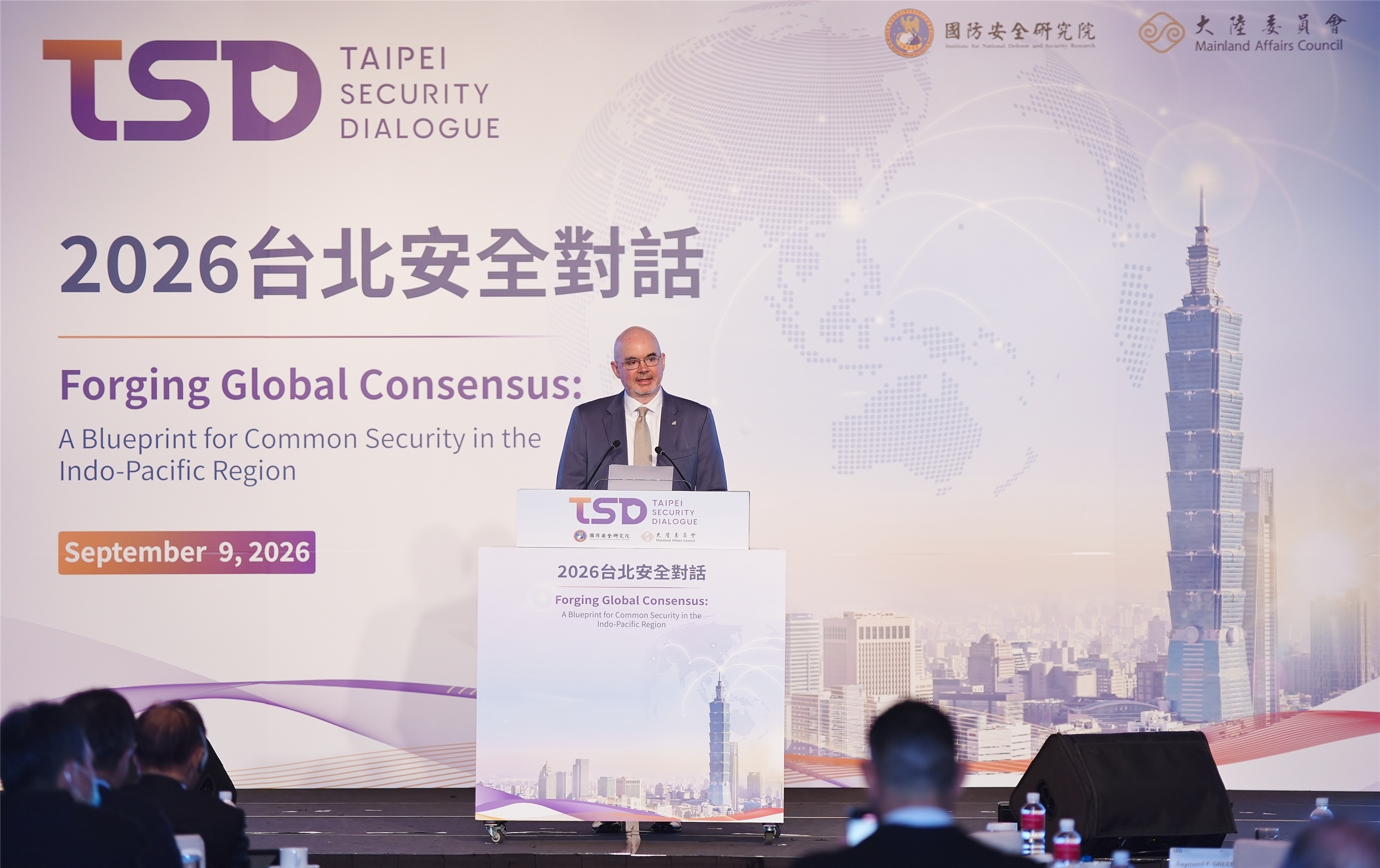
Taipei Security Dialogue: Securing Peace Through Asymmetric Deterrence
Introduction
Good morning, everyone. Let me begin by thanking INDSR for convening this forum. There is no topic more timely or important than how to secure peace in the Taiwan Strait. This matters for Taiwan, the Indo-Pacific region, and the world. As Secretary Rubio has said, “it is to the benefit of China, the United States, and the world writ large that there be stability in the Strait. That continues to be our position, and it’s one we will continue to stand by and advocate for.”
Beyond the human toll, any conflict across the Taiwan Strait would have a bigger impact on the global economy than the Second World War. The United States under the Trump Administration has made preserving peace in the Indo-Pacific one of its top priorities. We are doing so in three ways.
First is vigorous diplomacy, especially at the highest levels. The upcoming U.S.-China summit is an opportunity to further advance a relationship of strategic stability, on the basis of fairness and reciprocity, that can avoid misunderstandings and miscalculations. Second, we are reinforcing our presence and partnerships in the Indo-Pacific region, especially along the First Island Chain, to maintain a favorable regional balance of power. Third, and especially relevant to today’s discussion, we are supporting Taiwan’s work to enhance its ability to defend itself.
Setting the Record Straight: U.S. Policy & Taiwan’s Deterrence
Some have argued that Taiwan’s efforts to strengthen deterrence are somehow a provocation, and that U.S. support for Taiwan’s defense preparedness marks a change in our policy. Nothing could be further from the truth. Taiwan’s ability to deter conflict has and will continue to be foundational to preserving its vibrant political, economic, and social system. We also see effective deterrence as key to creating space for a genuine cross-Strait dialogue to resolve differences free from coercion or threats of force.
Since the passage of the Taiwan Relations Act in 1979, the United States has consistently supported Taiwan’s self-defense capabilities, providing equipment and services commensurate with the threats Taiwan faces. As Secretary Rubio has underscored, this is a continuation of a bipartisan commitment that is more than four decades strong, spanning administrations of both parties.
As we all know, the threats Taiwan faces continue to grow in scale and sophistication. However, Taiwan stands to benefit significantly from the lessons learned on the battlefields of Ukraine and the Middle East about the changing character of warfare. Through these conflicts, we are gaining insights into ways to prevent a similar outbreak of hostilities in the Indo-Pacific. Taiwan can and is employing lessons from these conflicts, especially the concepts of asymmetry, employment of new technologies, and warfighting on a transparent battlefield.
Compared to Ukraine or the combatants in the Middle East, Taiwan starts with many advantages.
It has one of the most impressive technology and manufacturing bases in the world, a booming economy with robust fiscal resources, and a highly capable and well-trained military.
Theory of Victory: Taiwan’s Strategic Advantage
Taiwan’s other major advantage is geography. To deter conflict, Taiwan doesn’t need to demonstrate that it could win a war outright. It simply needs to convince an adversary that it would struggle to successfully land a large ground force in heavily urbanized, mountainous terrain and sustain it across 90 miles of open, turbulent waters. It is hard to imagine a more difficult and complicated operation, even for a combat-experienced military force.
The Age of Asymmetry
Turning to today’s topic: recent conflicts reveal that we have entered a new era of warfare, an age of asymmetry that rewards ingenuity and rapid adaptation. Today’s panels will dig into the specific lessons Taiwan can draw from Ukraine and the Middle East.
I want to spotlight three areas where Taiwan can draw on its own unique asymmetric strengths to deter conflict: uncrewed systems, mission command, and societal resilience. I will also touch on two facilitators necessary for success: investment and reserve utilization.
Uncrewed Systems
Uncrewed systems are to today’s conflicts what the machine gun was in World War I and the tank in World War II: a game-changing technology that redefines the battlefield. Take for example Ukraine’s success without a formal navy in neutralizing the powerful Russian Black Sea Fleet and preventing Russia’s planned amphibious seizure of Odesa, or its more recent success in penetrating some of the most advanced air defense systems in the world to strike strategic targets deep inside Russia.
Ukraine built its world-class defense technology sector essentially from scratch, under fire, with a fraction of the industrial base Taiwan already possesses.
Taiwan is starting from a stronger foundation—advanced manufacturing, deep semiconductor expertise, and access to advanced American battle-tested autonomous systems, including Anduril’s Altius and Shield AI’s V-BAT.
Just as significantly, America’s leading drone companies are establishing deep production, R&D, and supply chain partnerships with Taiwan companies big and small. As a result, Taiwan’s drone exports are surging, and its manufacturers are winning access to demanding international markets. The United States and Taiwan are also pushing the boundaries of the uncrewed sectors with growing collaboration on maritime USVs and UUVs as well as AI-enabled swarming technologies. These platforms promise to significantly increase Taiwan’s deterrence capabilities in the coming years.
Of course, no single innovation is a silver bullet on its own. The real winning formula is integration: a “system of systems” fusing conventional and unmanned systems with survivable, multi-domain C4ISR that can operate in a complex kinetic and electro-magnetic threat environment – as is true in Ukraine.
Mission Command & Democratic Values
As we have seen in ongoing conflicts, the transparent, fast-paced modern battlefield presents challenges not just to technology and equipment but also their human operators. One of Ukraine’s early, and enduring, advantages has been its ability to exercise mission command — to push operational decisions down to the tactical level. We have watched this play out brilliantly in Ukraine, where soldiers empowered to make decisions at the point of contact have repeatedly outwitted a Russian military still shackled to rigid, top-down hierarchies.
The reason Ukraine has been able to succeed with mission command while Russia has failed is due to an asymmetric advantage that Ukraine and democracies like Taiwan share: they do not fear the loyalties of their own militaries. That trust isn’t sentimental—it can be operationally decisive. In high-intensity, communications-denied environments, the side that can act without waiting for permission from the top enjoys a distinct advantage.
That rigidity isn’t something that is easily fixed. Meanwhile, the most recent Han Kuang exercise demonstrated that Taiwan is quickly adapting to mission command concepts to ensure operational flexibility.
Societal, Energy & Information Resilience
Authoritarian powers see open societies as a vulnerability to exploit. Whether it is through media or electoral manipulation to sow divisions and undermine support for defense investments or direct attacks on civilians and economic infrastructure during conflict, the urgent need for democracies to enhance societal resilience is increasingly clear.
Taiwan’s public and civil sectors are not waiting for a crisis to start. I have observed multiple Urban Resilience drills over the past two years and have been consistently impressed with the progress made in enhancing coordination between central and local authorities and between civilian agencies and the Taiwan military. Just as significant has been the role of Taiwan’s vibrant civil sector, drawing on the island’s strong tradition of volunteerism and community support.
Taiwan has also systematically addressed economic vulnerabilities, especially in critical sectors like energy. While there is lots of international attention given to Taiwan’s efforts to expand LNG importation and storage, many miss the great strides Taiwan has made in enhancing its overall energy resilience. Whether it is devising plans for rationing, decentralizing its power grid, tapping into coal and renewable resources, or looking at new or renewed energy sources like nuclear and geothermal, Taiwan is far better positioned today than just a couple of years ago.
Taiwan’s ability to manage the impact of the Middle East conflict on its supply of energy and key imports like helium is a testament to its resilience efforts.
On the information front, Taiwan faces a daily barrage of adversarial propaganda aimed at sowing division and undermining confidence in its democratic institutions and partnerships—including with the United States. While Taiwan has been an international model in countering this type of media manipulation, it is necessary to prepare for a new, more sophisticated wave ahead of upcoming elections that will incorporate advances in AI. AI-enabled cyber threats are also likely to pose significant challenges to key sectors such as banking and critical infrastructure that require urgent action.
Defense Investments
Of course, preserving peace in the face of the unprecedented threats in the world requires significantly larger defense budgets.
With U.S. encouragement, Europe is moving off decades of underinvestment as are Australia, Japan and the Republic of Korea. Israel continues to show what sustained investment in self-defense delivers when conflict erupts. We see the Lai administration taking these same steps, including through his pledge to increase defense spending to 5 percent of GDP by 2030. Even more than many other partners, Taiwan is able to afford this choice. Taiwan’s debt-to-GDP ratio is amongst the lowest of advanced economies and its GDP and revenue growth are the envy of the world.
Spending more for weapons and equipment is necessary, but not sufficient. Regenerating capabilities during conflict is crucial, which calls for investing in the defense industrial base. Such investments offer both economic and security benefits. Taiwan has the technology and manufacturing capabilities not only to meet its own needs, but also to support the development of democratic supply chains around the world. The counterargument that investing in the defense industry risks stoking corruption is a distraction.
In fact, the ability of democracies — with their free press, legislative oversight, and internal watchdogs — to limit corruption is yet another asymmetric advantage over authoritarian states. Take for example the failures of Russian equipment during the initial invasion of Ukraine due to pervasive corruption in the military procurement system. Without transparency, authoritarian powers can’t know if their kit really works until they use it in combat. Taiwan’s complex and vibrant democracy is precisely what keeps that fate at bay. It is also why Taiwan’s ranking in the issue of tackling corruption continues to climb, with the most recent Transparency International survey putting it in the top 15% in the world.
Reserve Utilization
One common false argument against spending more for defense is that Taiwan doesn’t have the military personnel to utilize the equipment it is purchasing. Taipei is already providing the answer to this issue through better utilization of its reserve forces.
The extension of compulsory military service from four months to a full year, which took effect in 2024, is already reshaping the size and readiness of Taiwan’s ground force. The reformed one-year training pipeline means a new, better-trained cohort of 30,000+ reservist conscripts will enter the force structure next year, equipped with modern gear. If Taiwan builds on these policy changes, it can create the mass and expertise it needs despite continued demographic pressures.
Israel offers an inspiring model here—a small population that nonetheless fields a large, rapidly mobilizable force by treating its reserves as a core pillar of national defense. Taiwan has a real opportunity to apply that same logic to its own demographic picture, turning a smaller population into a deeper bench of trained, ready force. To fully achieve this effect, Taiwan could continue to extend the period of annual recall training and ensure that reservists’ skill sets are aligned with the military’s needs.
Taiwan also has a significant, largely untapped talent pool in its female population, representing real upside for its manpower base. Taiwan’s female enlistment rate already outpaces both Japan and the Republic of Korea, standing on par with the United States—a strong indicator of the depth and resilience already built into Taiwan’s force. Women also represent a clear majority of enrollment in civil defense courses on the island—they are eager to do their part.
Conclusion: Deterrence, Transparency & Securing Peace
Let me close on a high note by recognizing the impressive strides Taiwan has made since 2022. In the wake of Russia’s full-scale invasion of Ukraine and facing unprecedented provocations across the Taiwan Strait later that same year, Taipei has moved decisively to bolster its defenses. We saw this progress on full display in the most recent Han Kuang exercise, with Patriot missile batteries and armored brigades rolling through urban streets in scenarios that would have been unthinkable just a few years ago.
This isn’t incremental change; it is a fundamental shift in how seriously Taiwan approaches its own defense, and it deserves real recognition.
At the same time, neither we nor Taiwan can rest on our past successes. We are constantly learning new, and often hard, lessons from Ukraine and the Middle East. Incorporating those into the way Taiwan prepares to fight will ensure those lessons never have to be applied in an actual war here. That’s the goal here and around the world—not victory in conflict, but the prevention of it altogether. And that is a future well within our reach with your help today.
謝謝大家。