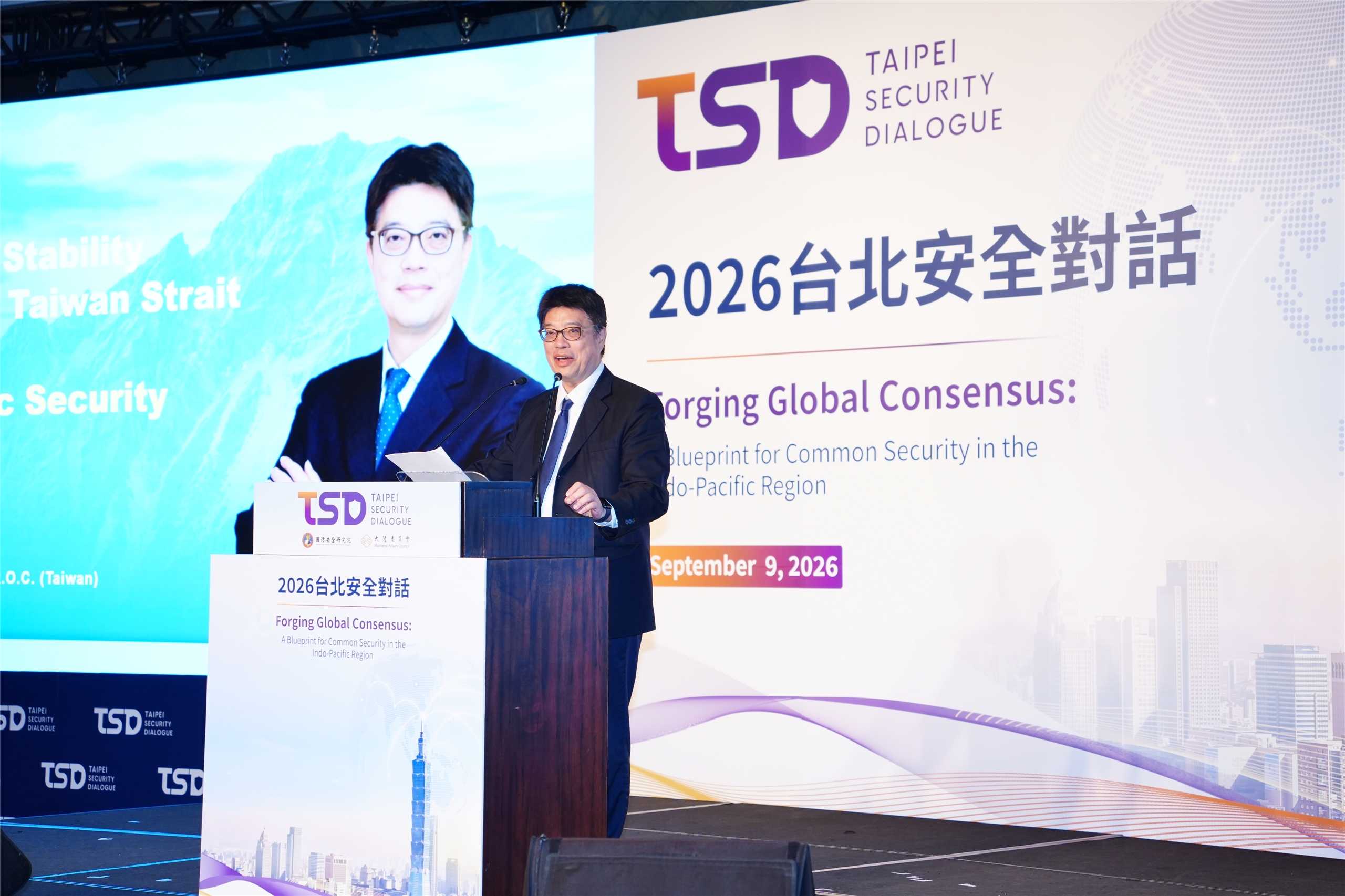
Chairperson Huo Shou-Ye of the Institute for National Defense and Security Research; Deputy Minister Sung Chen-En of Ocean Affairs Council; former Principal Deputy Assistant Secretary Royer of War for Indo-Pacific Security Affairs, distinguished guests, scholars, and experts, good afternoon!
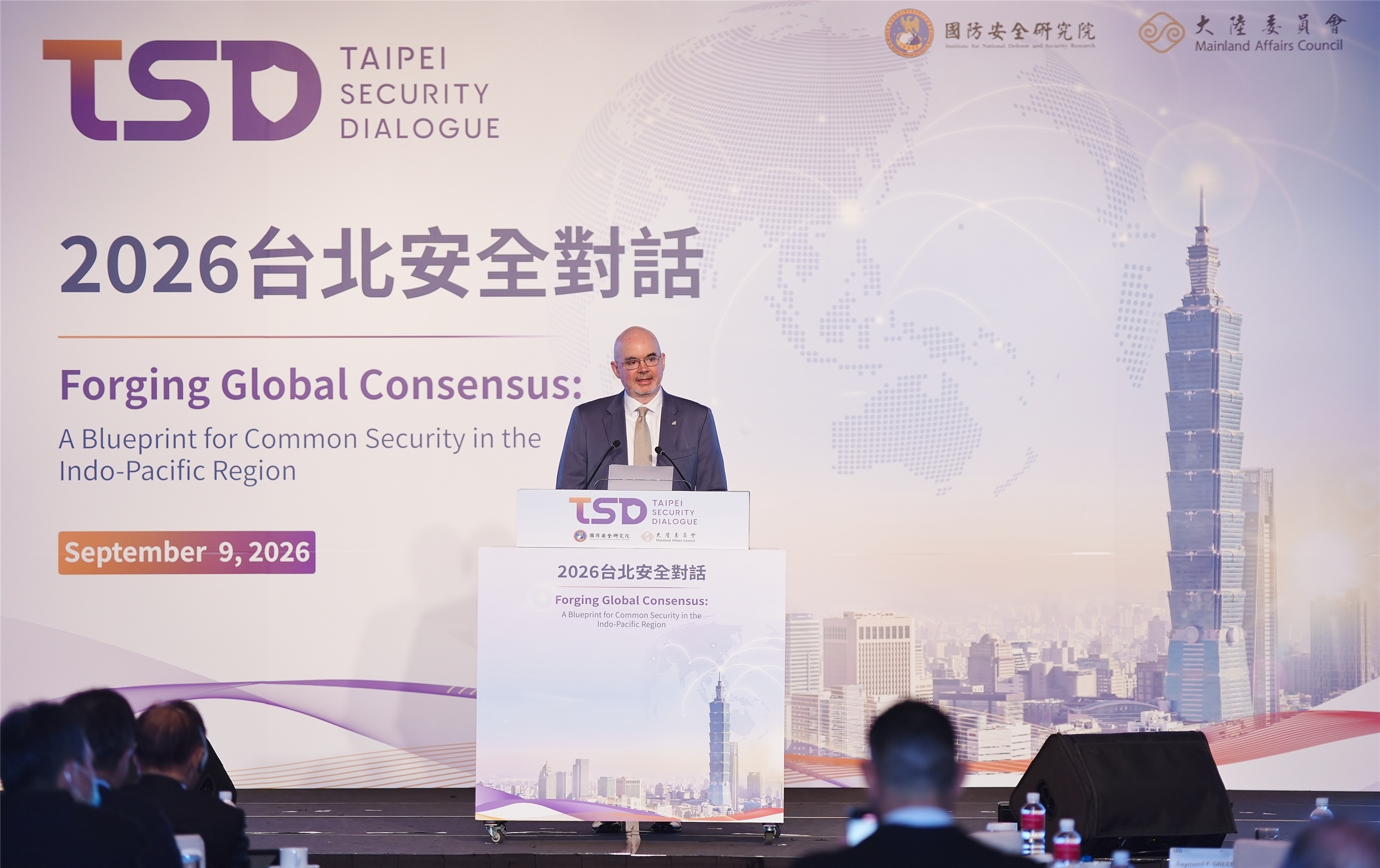
Today, I am deeply honored to be invited to attend the 2026 Taipei Security Dialogue symposium. The theme this year is "Forging Global Consensus: A Blueprint for Common Security in the Indo-Pacific Region." Having so many important experts and scholars from near and afar gathered here to offer insights on crucial issues, such as the global security landscape, emerging technological innovations, gray-zone threats and responses, is highly valuable. It is even more prominent at a time when the international order is increasingly challenged by totalitarian states like China. I would like to take this opportunity to share some observations.
First, the CCP Xi regime is the greatest threat to peace and stability in the Taiwan Strait and the Indo-Pacific region.
In recent years, under the leadership of Xi Jinping, China has posed an increasingly severe challenge to the international and regional order. To analyze the root cause, we must understand the true nature of the Xi regime. Since Xi came to power in 2012, political developments in mainland China have demonstrated three extreme developments.
The first is the shift from the "collective leadership" to "centralized leadership," even to the "one-man rule" under Xi, which has increased the risk of misjudgments in decision making.
The second, is the incitement of "fanatic nationalism." This includes seeking military hegemony, pushing "wolf warrior diplomacy," and using the "whole-of-nation system" to militarize the South China Sea, suppress ethnic minorities, crack down on Hong Kong's democracy, intensify pressure on Taiwan, and expand its global influence through the Belt and Road Initiative.
The third extreme development is making "unifying with Taiwan" and "replacing the United States" his historical mission, the benchmarks for achieving "the great rejuvenation of the Chinese nation," in order to justify his legitimacy to stay in power.
Under these three extreme developments, Beijing has intensified domestic suppression and expanded aggressively abroad, moving toward an unprecedented form of "new totalitarianism." Xi has leveraged multilateral mechanisms such as the Shanghai Cooperation Organization (SCO) and BRICS summit to promote a multipolar international order, as well as strengthen their strategic coordination with Russia and North Korea. In terms of military capability, China continues to build up its armed forces and expand its military capability. China even test-fired a submarine-launched intercontinental ballistic missile (ICBM) into the South Pacific this July, intimidating regional countries. China has indeed become the greatest threat in the Taiwan Strait and the Indo-Pacific region.
Second, the CCP is gradually advancing its strategy of "exercising jurisdiction before achieving unification" over Taiwan.
Since Xi started his 3rd term in 2022, China has been using compound pressure to repress Taiwan. This includes military intimidation, diplomatic suppression, economic coercion, social infiltration, lawfare and cognitive warfare, aiming to "coerce Taiwan onto the path toward unification." As Xi will be entering his fourth term in 2027, we assess that Beijing's Taiwan policy will shift toward a strategy of "exercising jurisdiction before achieving unification." This is to even more aggressively alter the status quo in the Taiwan Strait.
On August 17, at the centenary of Jiang Zemin's birthday, Xi Jinping cited Jiang's past remarks that "the Chinese nation will achieve great rejuvenation on the foundation of national unification" and asserted that this is "becoming a reality step by step".
Currently, China is shaping the momentum toward unification. The strategy toward Taiwan is not simply "unification by force" or "peaceful unification." Instead, it focuses on a more aggressive, provocative and "unilateral" series of actions to achieve its "exercising jurisdiction before achieving unification" goals.
That includes four aspects:
1. Domesticating the Taiwan issue in terms of administrative and judicial jurisdiction: For example, China conducted patrol and law-enforcement in waters east of Taiwan proper, comprehensively denying and compressing Taiwan's jurisdiction.
2. Incorporating their One China Principle into international institution. This means that China will, for example, continue to distort the UNGA 2758 resolution, suppressing Taiwan's international space through "One China on the international stage."
3. Granting national treatment: This could mean to treat Taiwanese people as Chinese nationals, and further encouraging Taiwanese people to work, study, live or invest in China.
4. Integrating Taiwan's offshore islands with China's coastal cities: For instance, they are using infrastructures, such as airports and bridges, to enhance their integrated development measures toward Taiwan's outlying islands.
By continuously intensifying "unilateral, expanding actions," China turns those actions from "simply responding to certain incidents" to a "new normal," using quantitative changes to lead to qualitative changes. Beijing's intention is to obtain jurisdictional governance and international recognition before the Taiwan issue is resolved, to achieve a "de facto unification." As Xi enters his fourth term, Beijing will advance unilateral integration more aggressively, normalize "exercising jurisdiction before unification", and push forward its "unification model for Taiwan" agenda.
Third, the Peace and Stability in the Taiwan Strait is the key to safeguarding global security and prosperity.
Under the intensifying and compound pressure from China, Taiwan possesses unique strategic importance and is an indispensable cornerstone for maintaining global prosperity, peace, and stability. There are three Taiwan' irreplaceable strategic importance
1. Geopolitical importance. Taiwan sits at the core position of the first island chain. Around 50% of the world's container ships transit the Taiwan Strait, making it crucial to maintaining global prosperity.
2. Economic and technology importance. About 90% of the world's most advanced process chips are produced in Taiwan, showcasing that Taiwan is an outstanding and reliable partner in the global high-technology supply chain.
3. Freedom and democracy. The democratic experience of the Taiwanese people can cross borders and inspire the people of mainland China to pursue a better lifestyle, possessing irreplaceable importance within the global democratic camp.
Therefore, maintaining security and peace in the Taiwan Strait directly affects the vital interests of all countries. In recent years, G7 nations (including the US, Japan, the UK, and France), the European Union, and Indo-Pacific countries such as New Zealand, Australia, and the Philippines have all expressed high concern for peace and stability in the Taiwan Strait. This demonstrates that maintaining the peaceful status quo in the Taiwan Strait and the region has become a major consensus in the international community.
Fourth, President Lai's cross-Strait policy is committed to maintaining the peaceful and stable status quo in the Taiwan Strait, which aligns with the shared interests of the international community
Maintaining peace and stability in the Taiwan Strait and preventing China from unilaterally changing the status quo is Taiwan's national strategic goal. Our government's cross-Strait policy upholds the principle of "neither yield nor provoke" and maintaining the status quo. We firmly defend our national sovereignty and our free, democratic, and rule-of-law-based way of life, and insist that the future of Taiwan must be decided by its 23 million people.
The government will continue to implement the "Four Pillars of Peace action plan", which includes strengthening national defense capabilities, building economic security, and strengthening partnership with democratic countries, and firmly safeguarding peace in the Taiwan Strait and regional stability.
Taiwan is a responsible member of the international community and a defender of the peaceful and stable status quo in the Taiwan Strait. Taiwan cherishes peace but will never give up freedom; Taiwan is willing to engage in dialogue, but will not accept being downgraded; Taiwan pursues stability but will not sacrifice its sovereignty and democratic values.
Taiwan is willing to facilitate healthy and orderly exchanges with the Beijing authorities under the principles of parity and dignity, but firmly rejects united-front tactics that "package unification in the guise of peace." We also call on the CCP to face up to the objective reality of the existence of the Republic of China (Taiwan) and engage in pragmatic dialogue with Taiwan's democratically elected government.
Finally, I would like to once again thank the Institute for National Defense and Security Research (INDSR) for organizing this international symposium, as well as our distinguished guests for their insights. I wish you all the best. To our foreign friends, I wish you a wonderful trip in Taiwan. Thank you very much!